Stellarator Turbulence: Closed and Open Field Lines
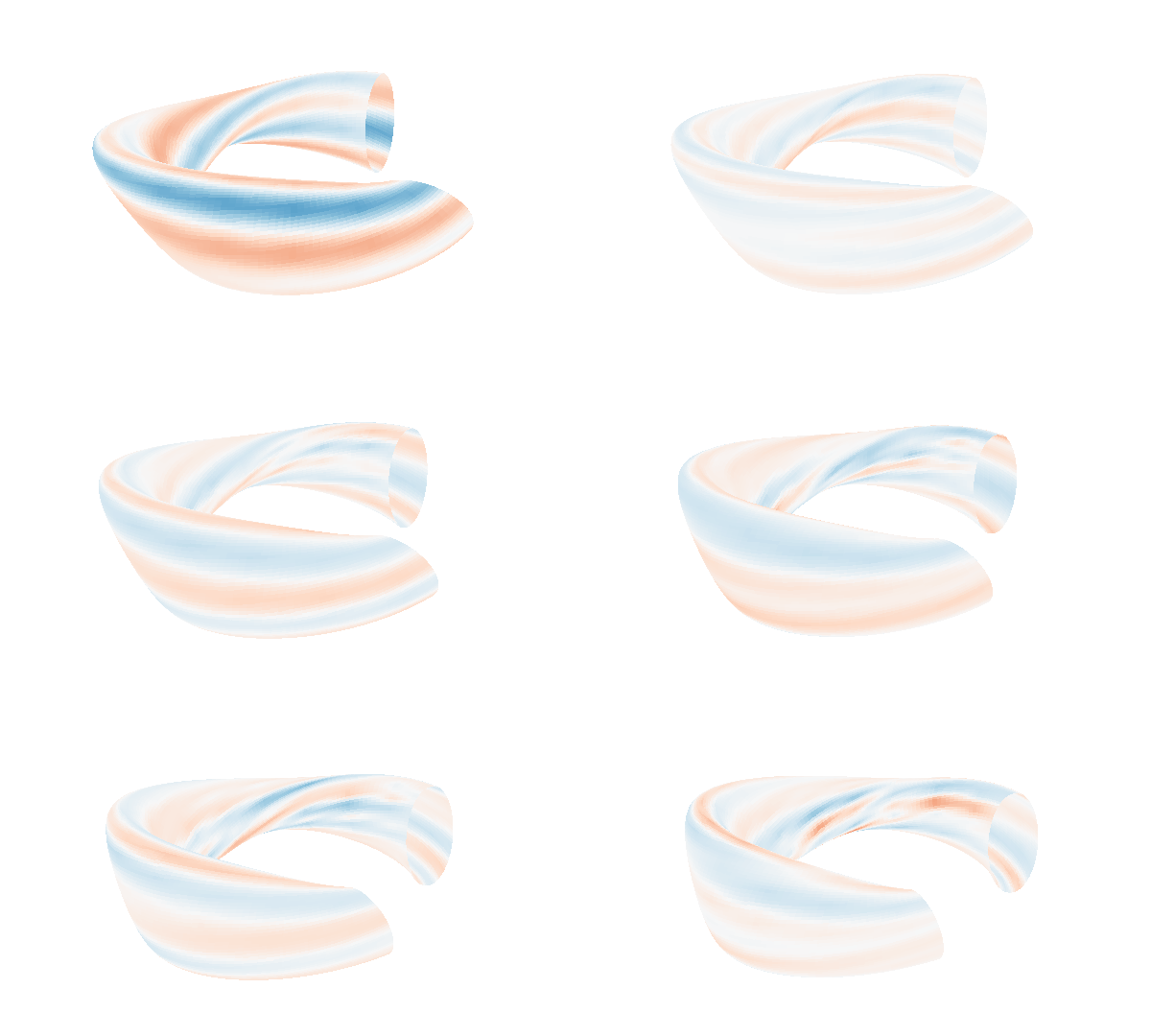
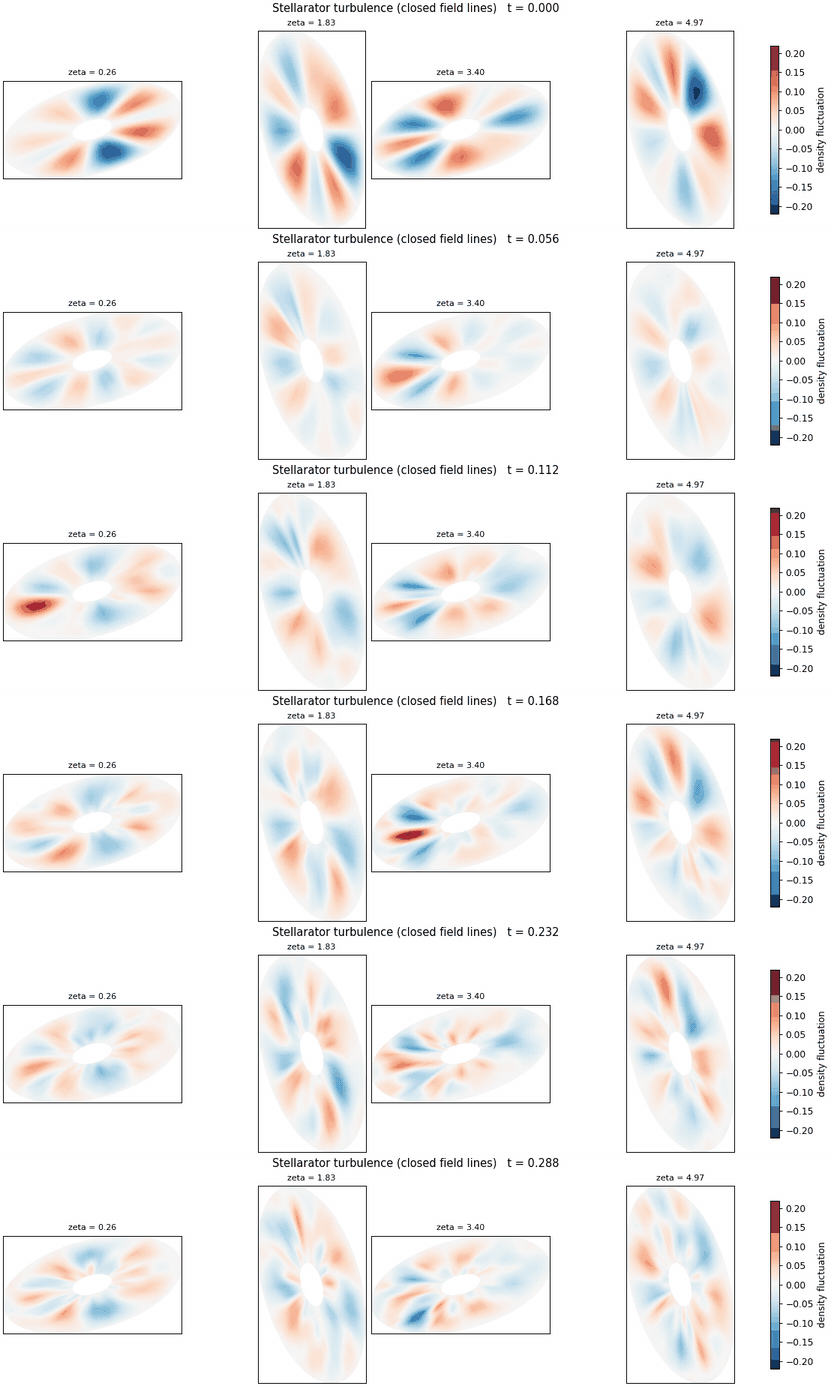
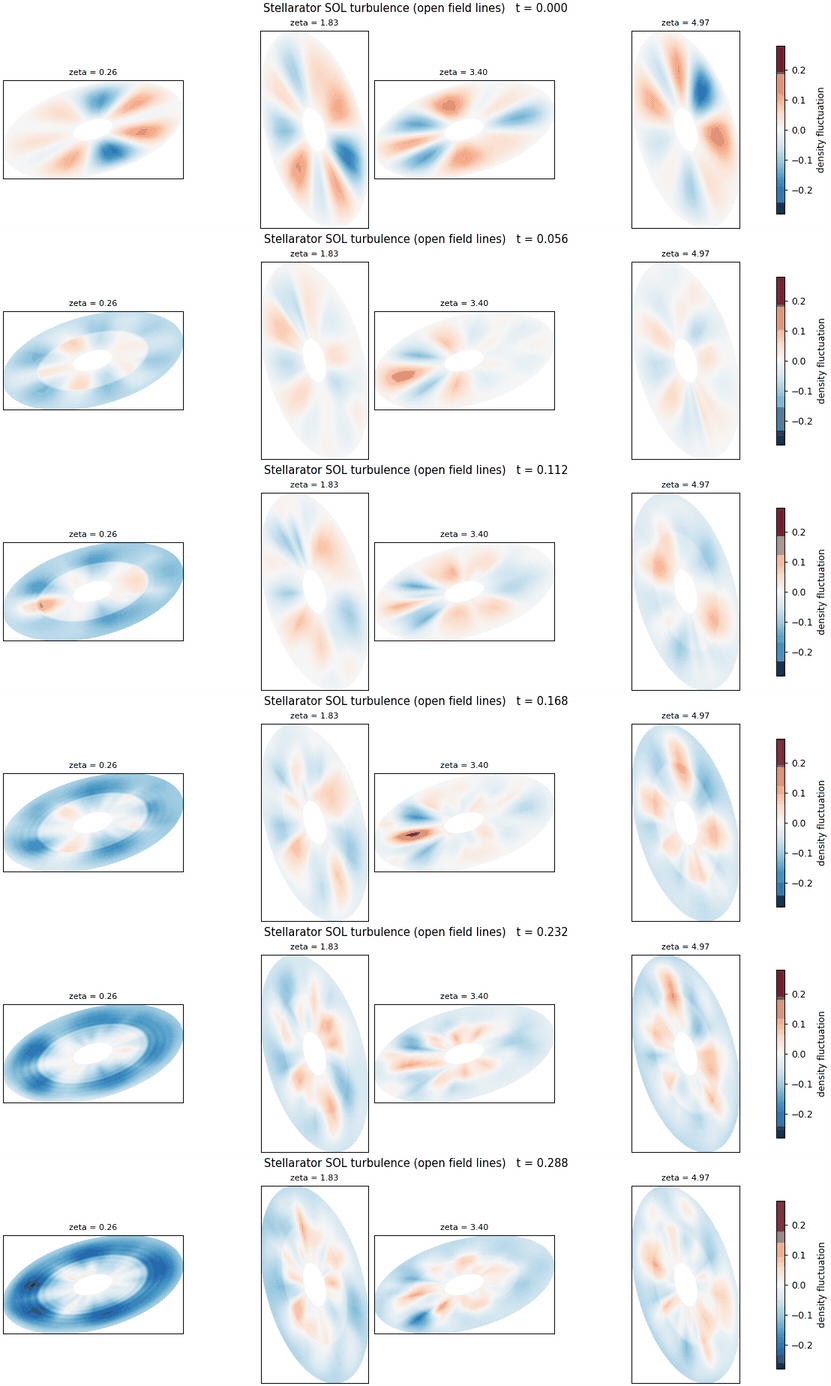
The four-field interchange model (density, vorticity, ion/electron parallel velocity) runs turbulence-type dynamics on the genuinely non-axisymmetric rotating-ellipse stellarator, on closed field lines and — with a toroidal limiter — on open ones. A random-phase multi-mode density seed (no initial vorticity or flow) is amplified by the curvature drive into interchange dynamics that differ plane-by-plane because the flux surfaces rotate with the toroidal angle.
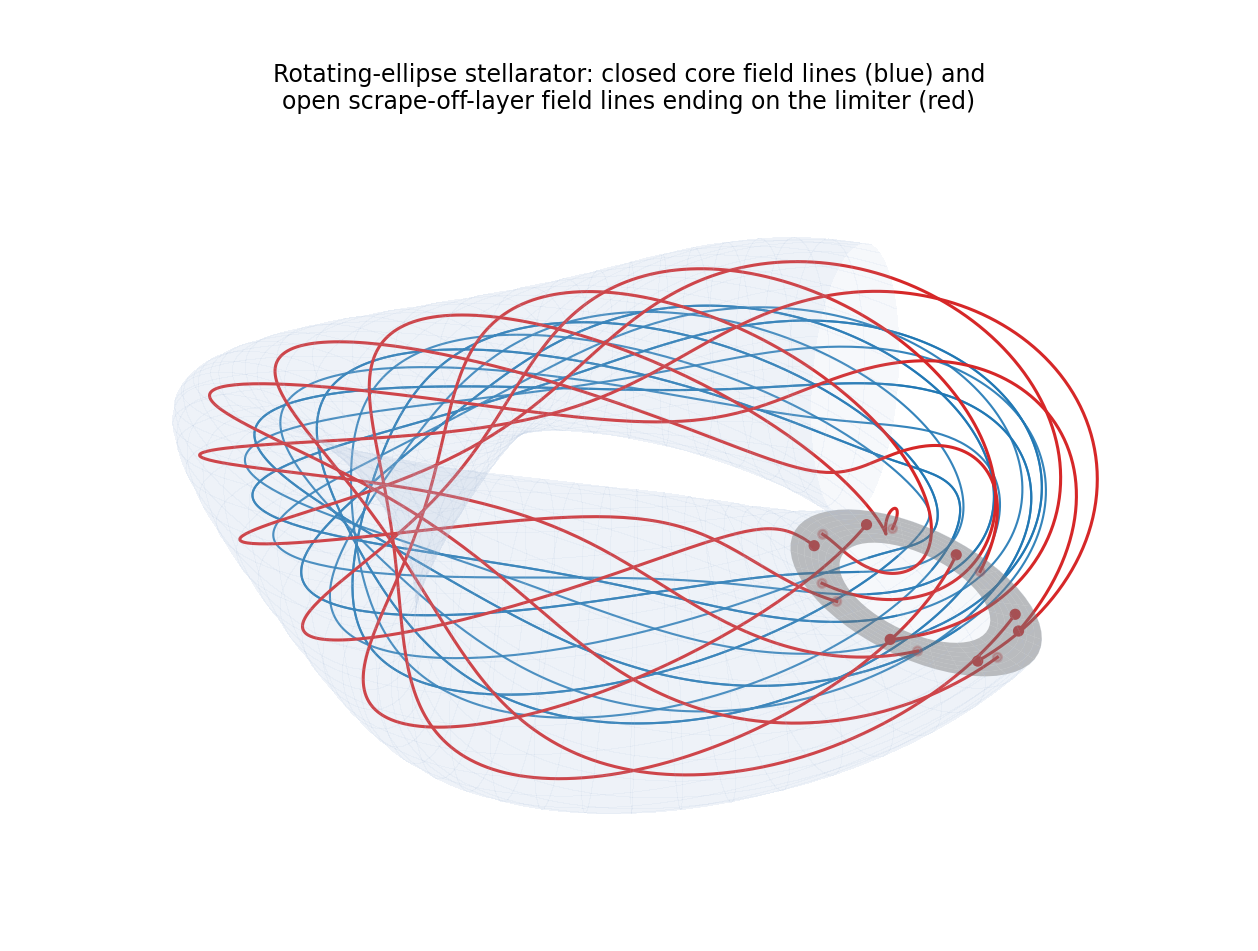
In three dimensions — the cutaway torus colored by the evolving density fluctuation, and the field-line topology (closed core in blue, open scrape-off-layer lines ending on the limiter in red):
| Closed field lines | Open field lines (limiter SOL) |
|---|---|
 |
 |
Open field lines: the limiter
build_rotating_ellipse_geometry(..., limiter_radius=r) opens every field line
with x > r on a toroidal limiter at the zeta = 0 plane — their forward
field-line maps exit on the last toroidal plane and their backward maps on the
first — while x <= r remains a closed core. The FCI endpoint masks then mark
exactly the scrape-off-layer surfaces, and the Bohm sheath closure
(compute_fci_sheath_recycling) drains them at n c_s each step. The summary
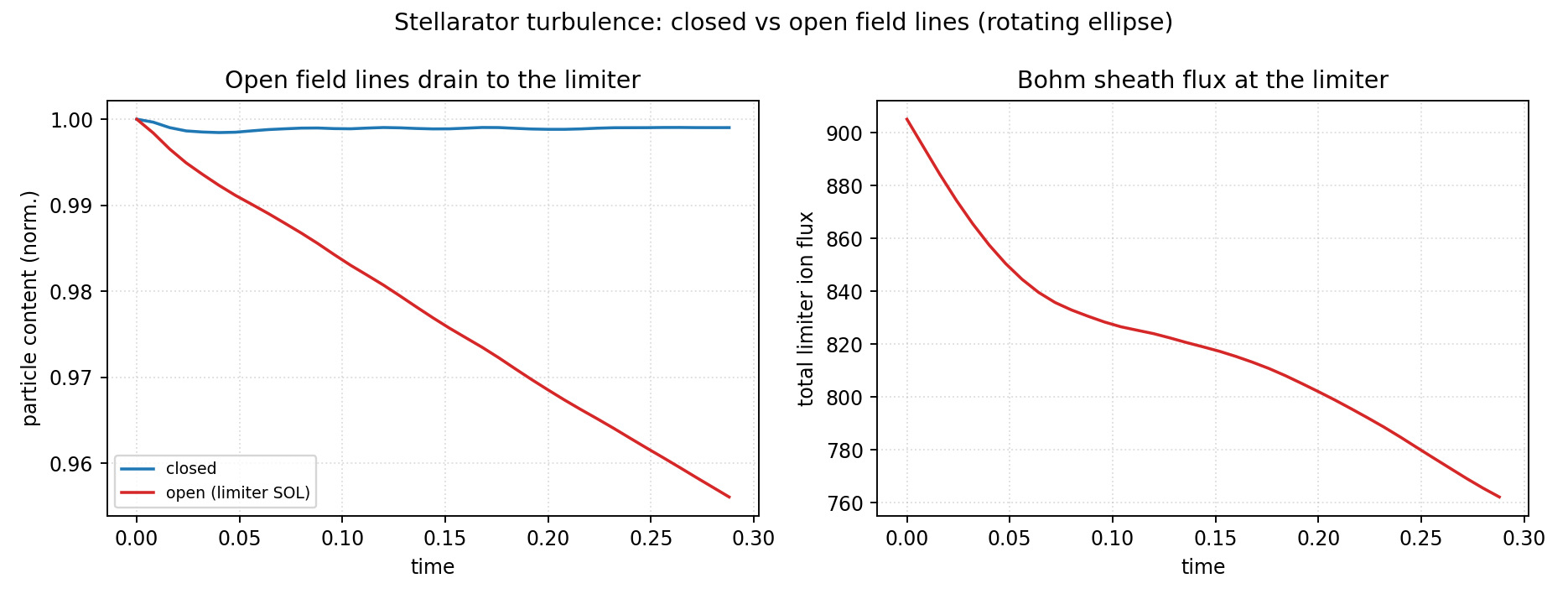
figure of the demo shows the consequence: with the same seed, the open run
loses particle content through the limiter while the closed run conserves it.
What is checked
tests/test_stellarator_turbulence.py
pins, at reduced resolution:
- the limiter opens exactly the scrape-off-layer flux surfaces at the limiter planes and nothing else (the core stays closed);
- the closed run stays finite and positive and the curvature drive generates interchange vorticity from the pure-density multi-mode seed; and
- the open run has positive Bohm limiter flux and drains particle content faster than the closed run with the same seed — the open-field-line channel isolated by construction.
The shared driver lives in
src/drbx/native/stellarator_turbulence.py
(the whole-step jitted run_stellarator_turbulence, the phi-solver builder,
and the free-decay boundary conditions); the physics is entirely the validated
four-field stack in drbx.native. The movie scripts cache completed runs
in closed_frames.npz / open_frames.npz and reuse them when present, so
re-rendering the movies does not re-run the physics.
Island divertor (B8)
Beyond the hand-placed limiter, the analytic island-divertor field
(drbx.geometry.island_divertor)
carries a sheared rotational transform crossing the 2/3, 3/4, and 4/5 rational
surfaces, each opened by a resonant radial perturbation. The overlapping chains
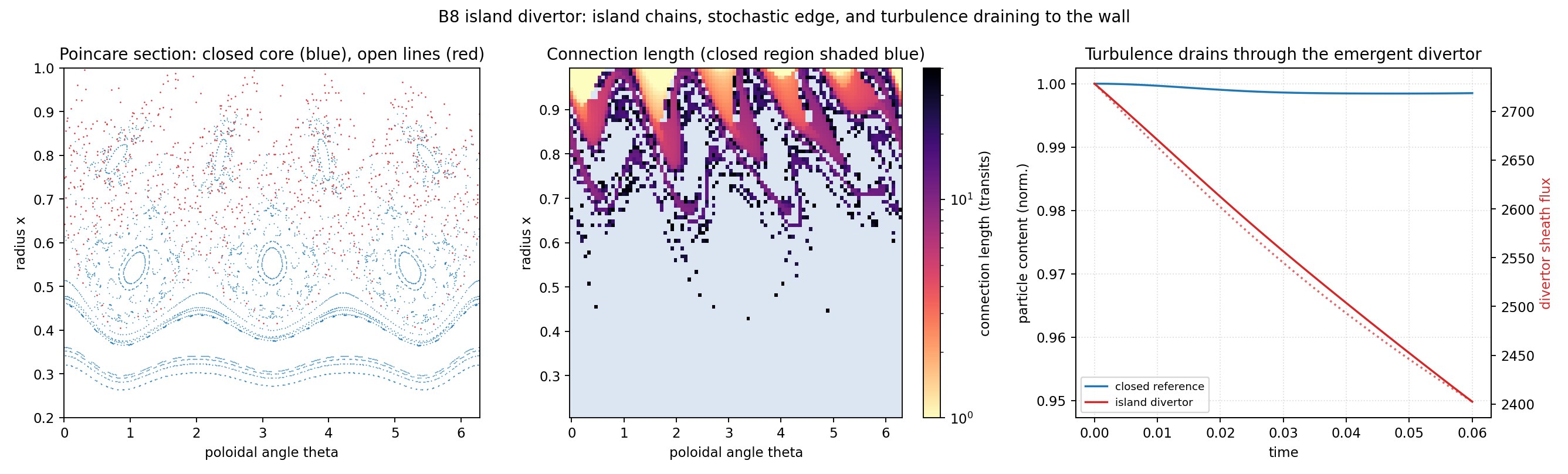
make the edge stochastic, and the open scrape-off layer emerges from the
field itself: multi-transit field-line tracing
(island_divertor_connection_length, pure JAX) marks a cell open when its line
reaches the wall within a finite connection length — closed core, island
chains, stochastic SOL.
The gate tests/test_island_divertor.py
pins the topology (core surfaces closed over 40 transits, stochastic-edge lines
open with finite, ordered connection lengths), the emergent masks (closed core,
90% open at the wall), and that the four-field turbulence drains through the emergent divertor faster than the closed reference with the same seed.
PYTHONPATH=src python examples/stellarator/island_divertor.py
pytest -q tests/test_island_divertor.py
Honest scope
These are short, bounded, seeded runs showing turbulence-type interchange dynamics on non-axisymmetric closed and open field lines — not statistically saturated stellarator turbulence, which needs longer implicit-stepped runs.
Reproduce
PYTHONPATH=src python examples/stellarator/stellarator_turbulence.py
PYTHONPATH=src python examples/stellarator/stellarator_3d_render.py   # 3D movie + field lines
pytest -q tests/test_stellarator_turbulence.py