Rotating-Ellipse FCI
The rotating-ellipse (l = 2) stellarator is the canonical minimal
non-axisymmetric magnetic field: a torus whose elliptical cross-section rotates
as it is followed around toroidally, so the metric depends on all three
logical coordinates. It is the reference geometry for checking that the
flux-coordinate-independent (FCI) parallel operators are correct on a genuinely
three-dimensional field, and it is the flagship non-axisymmetric benchmark in
drbx.
Geometry
The logical coordinates are (x, theta, zeta) with a minor-radius label x and
periodic poloidal / toroidal angles. The physical embedding into Cartesian space
is
p0  = (1 + delta) * x * cos(theta)
q0  = (1 - delta) * x * sin(theta)
lam = n_field_periods * zeta
p   = cos(lam) * p0 - sin(lam) * q0
q   = sin(lam) * p0 + cos(lam) * q0
R   = r0 + p
X, Y, Z = R cos(zeta), R sin(zeta), q
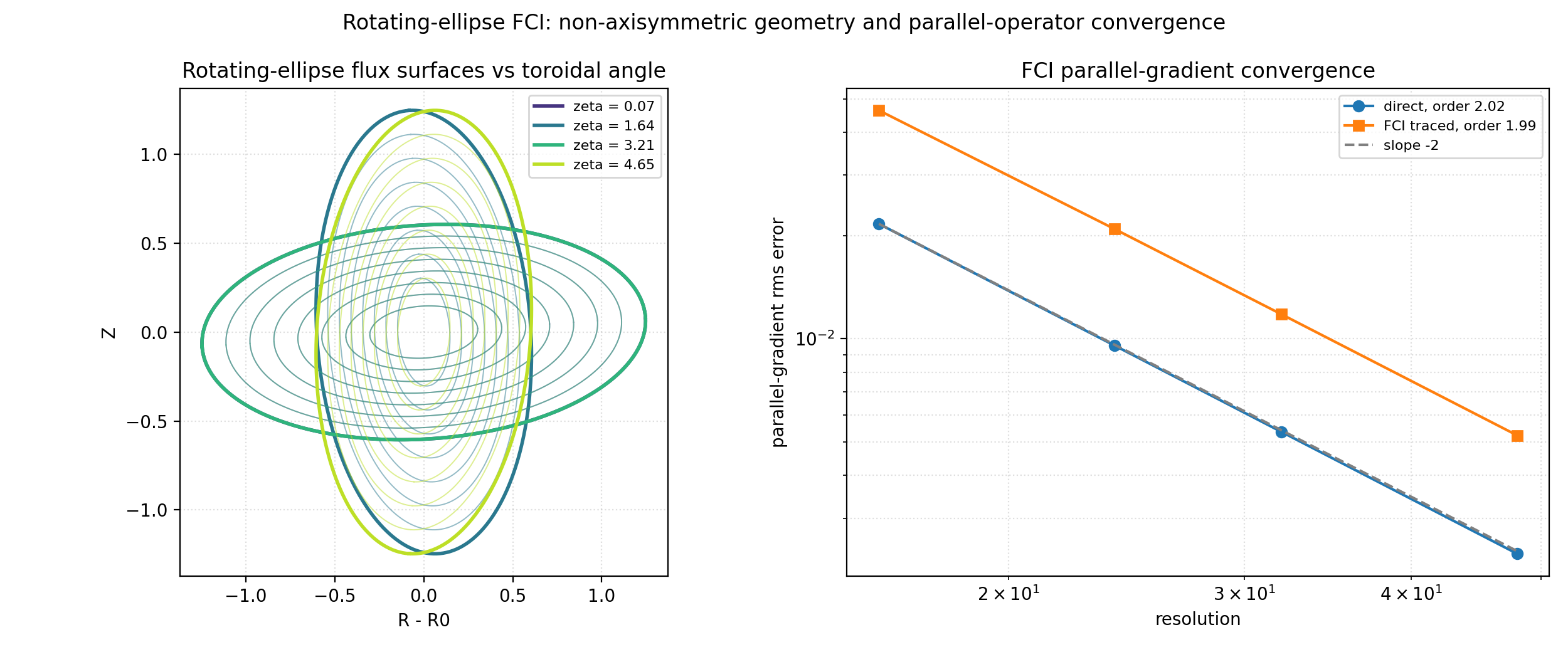
so a surface x = const is an ellipse of elongation (1 + delta) / (1 - delta)
whose major axis rotates n_field_periods times per toroidal turn. The left
panel of the figure shows the nested flux surfaces at four toroidal angles: the
ellipse orientation genuinely turns with zeta.
The metric is obtained by automatic differentiation of this embedding,
g_ij = d_i X . d_j X, rather than by hand. This keeps the construction exact
(the contravariant and covariant metrics are a consistent inverse pair to
machine precision) and differentiable with respect to the shape parameters
themselves — the same autodiff that builds the metric gives the gradient of any
geometric diagnostic with respect to the elongation, which is what makes
stellarator-shape optimization through the FCI stack possible.
The magnetic field is helical on the flux surfaces, B^x = 0,
B^theta = iota * c_phi / J, B^zeta = c_phi / J, so its field lines wind with
rotational transform iota and never leave a surface.
The constructor is
drbx.geometry.build_rotating_ellipse_geometry;
the embedding is exposed separately as rotating_ellipse_position.
What is checked
The gate in
tests/test_rotating_ellipse_fci.py
pins:
- Non-axisymmetry and metric consistency — the covariant metric varies along
the toroidal axis (an axisymmetric geometry would be constant in
zeta), the contravariant/covariant pair inverts to the identity to better than1e-10, and the Jacobian stays positive. - Second-order parallel-gradient convergence — with a manufactured field, the
FCI parallel gradient converges at order 2 on the rotating-ellipse metric, both
for the direct
b^i d_i foperator and for the traced-field-line operatorgrad_parallel_op_fci, which follows the field lines between toroidal planes (the FCI-specific path). The right panel of the figure shows both tracking the slope--2reference line. - Shape differentiability —
jax.gradof a metric diagnostic with respect to the ellipse elongation matches a central finite difference.
The rotating ellipse is a standard FCI convergence test case (see Stegmeir et al., Comput. Phys. Commun. 198, 139 (2016), the GRILLIX field-line-map approach).
Seeded-filament dynamics
Beyond the linear operator gate, the four-field drift-reduced FCI model (density, vorticity, ion/electron parallel velocity) runs a seeded filament on this geometry. A localized density blob is initialised with no vorticity; the curvature drive then generates vorticity from the pressure blob -- the interchange mechanism that moves a filament -- and because the flux surfaces rotate with the toroidal angle, the filament evolves differently in each toroidal plane.
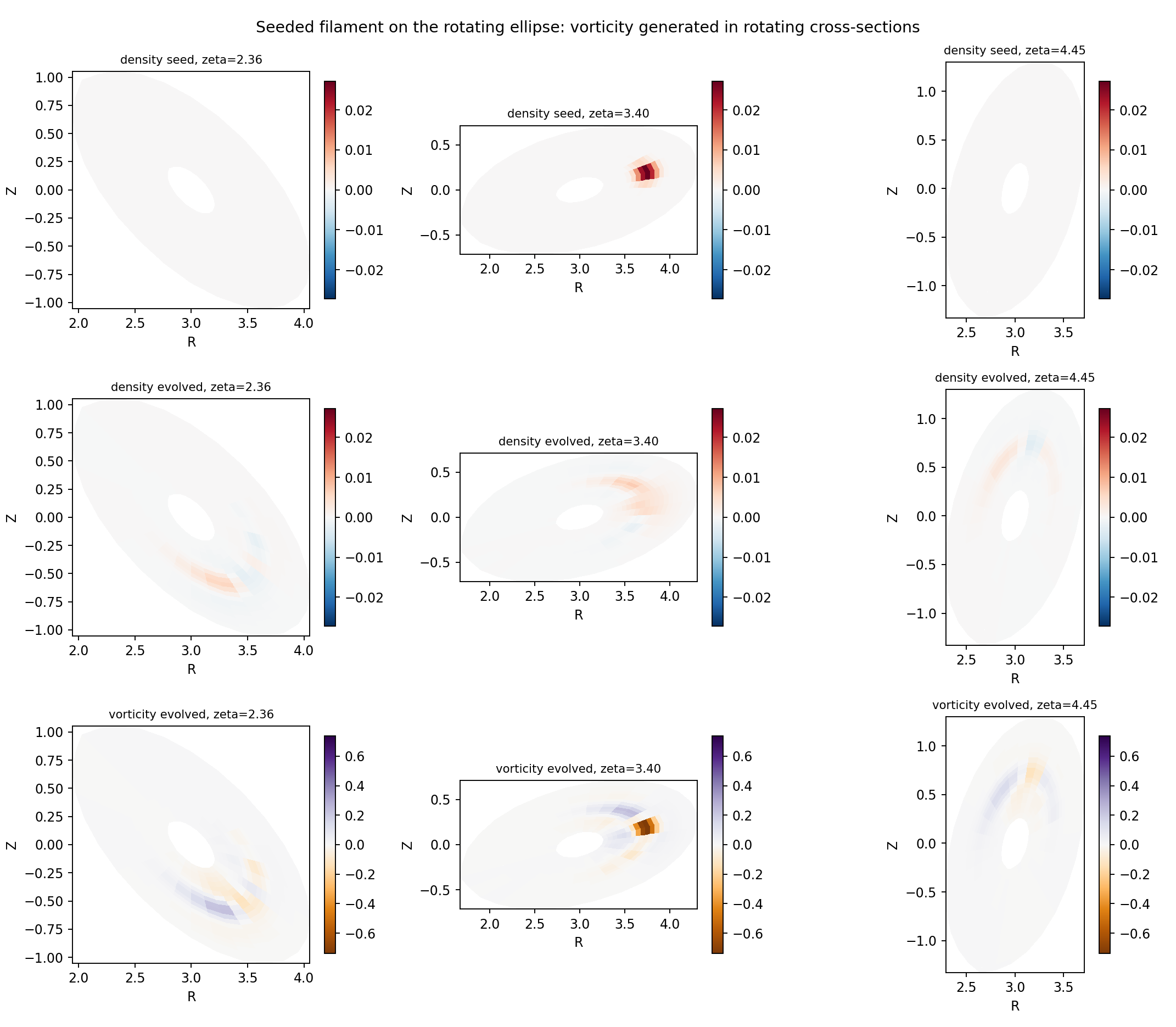
The figure shows, in physical (R, Z) cross-sections at three toroidal angles
(each a differently oriented ellipse), the seeded density blob, the evolved
density, and the evolved vorticity: a clear interchange dipole develops, oriented
with the local rotated cross-section. The gate
tests/test_rotating_ellipse_filament.py
pins that the run stays finite, the density stays positive and bounded, and both
vorticity and a parallel ion flow are generated from the seed. Regenerate the
figure with
PYTHONPATH=src python examples/stellarator/rotating_ellipse_filament.py
Reproduce
PYTHONPATH=src python examples/stellarator/rotating_ellipse_fci.py
writes output/rotating_ellipse_fci/ with the two-panel figure (rotating flux
surfaces + parallel-operator convergence) and a JSON summary. Run the gate with
pytest -q tests/test_rotating_ellipse_fci.py